Launch offer — valid today only

📄 Digital book in PDF · read it on your phone or print it

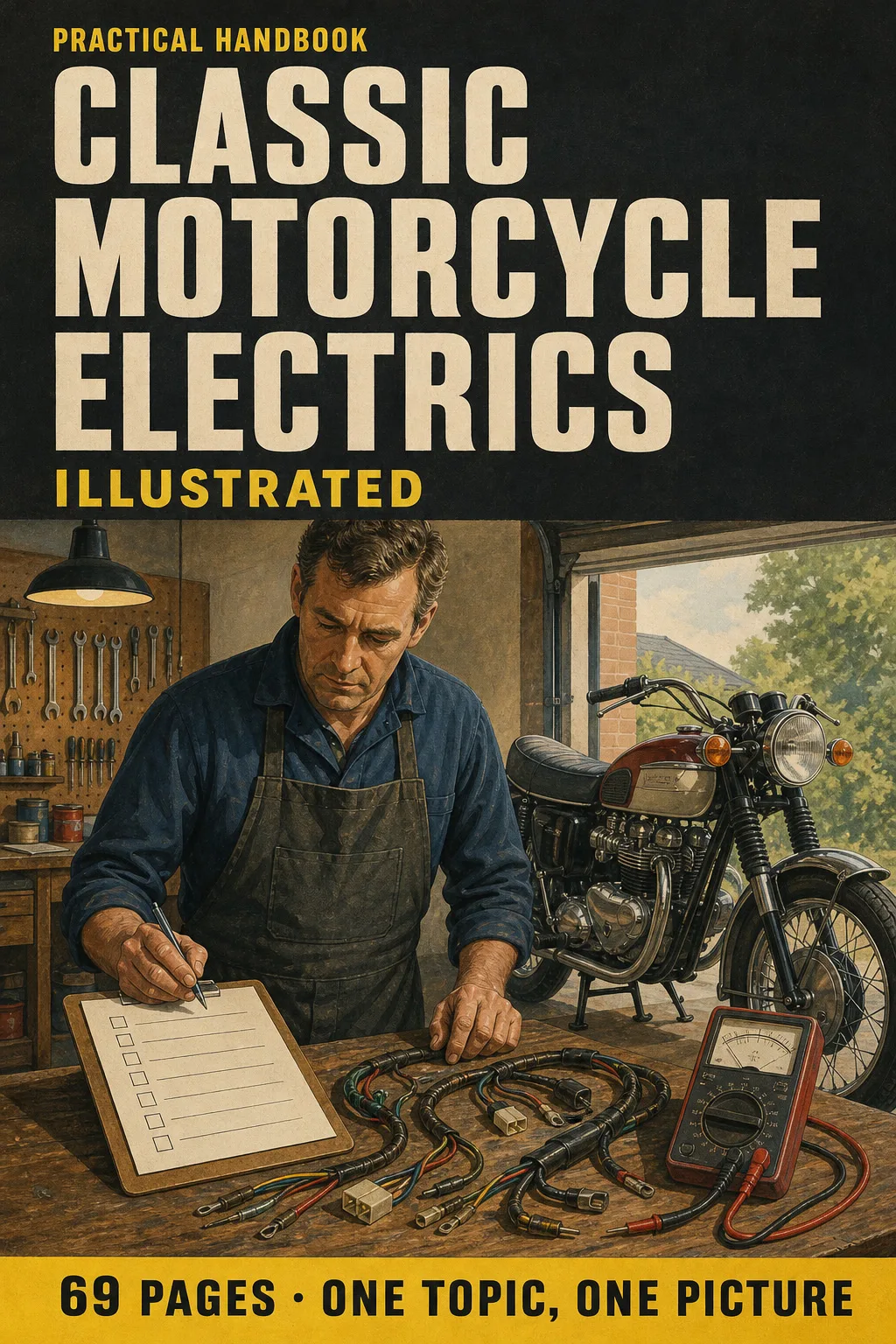
Classic Motorcycle Electrics Illustrated: Wiring, Ignition and Charging in Drawings Find Faults in 4 Steps, Always in the Same Order

Wiring diagrams, the British colour code, the battery, dynamo and alternator, points and timing, lights, multimeter fault-finding and a new loom. Each topic has its own page: the drawing first, then what you need to remember. 69 illustrated pages.

START FAULT-FINDING THIS WAY

🔒 Secure checkout · PDF by email · 30-day guarantee

Every topic, its own pageEach circuit drawn as a loop, with the explanation alongside
69 illustrated pages8 parts, from the circuit as a loop to your machine's data page
Up-to-date sourcesLights checked against the Road Vehicles Lighting Regulations 1989 and the MOT inspection manual
PDF by emailFormat

Look Inside the Book

Every page has one big drawing and a box with the readings, steps and checks you need:

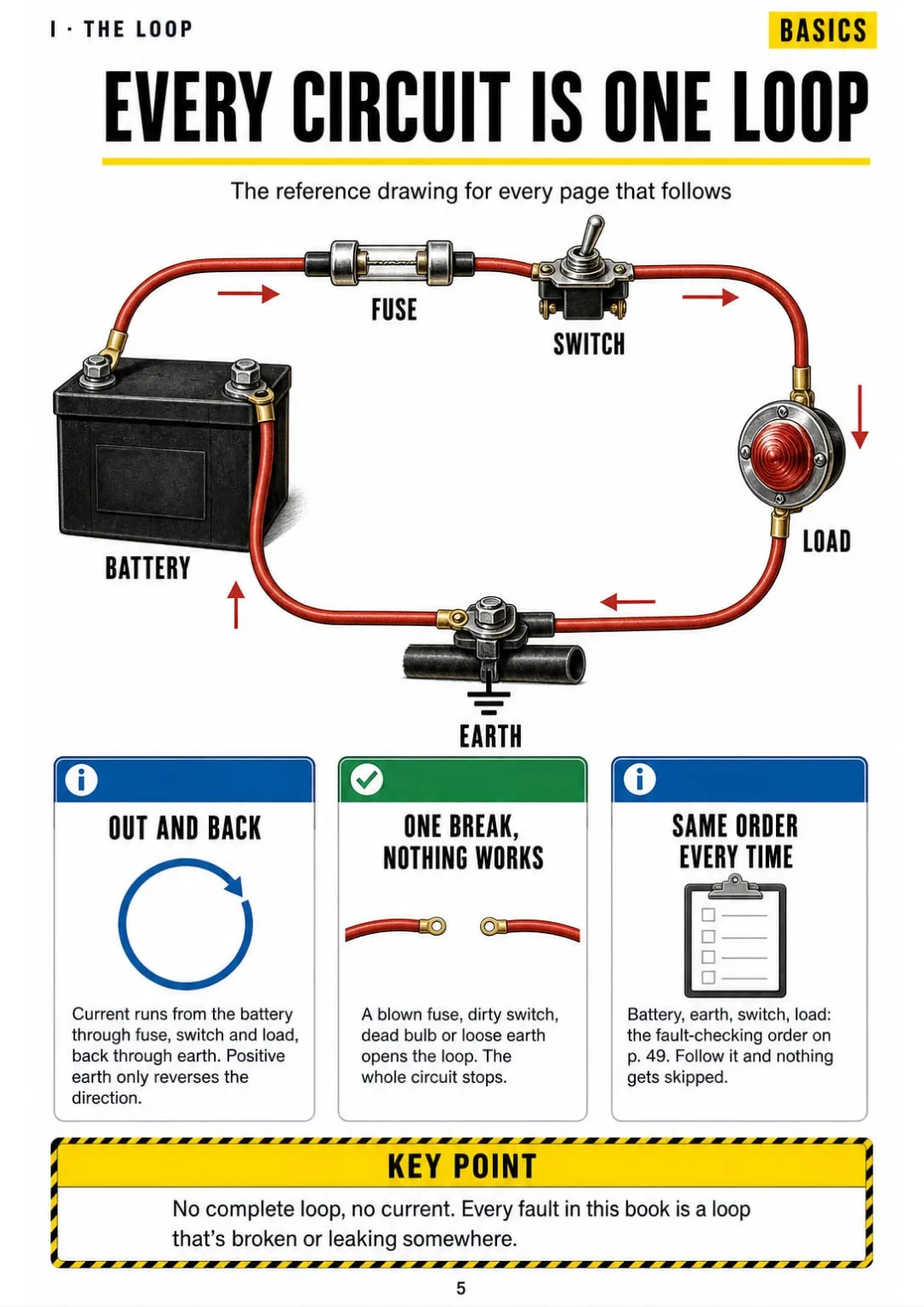
Battery → fuse → switch → load → earth → battery: one loop, one drawing.
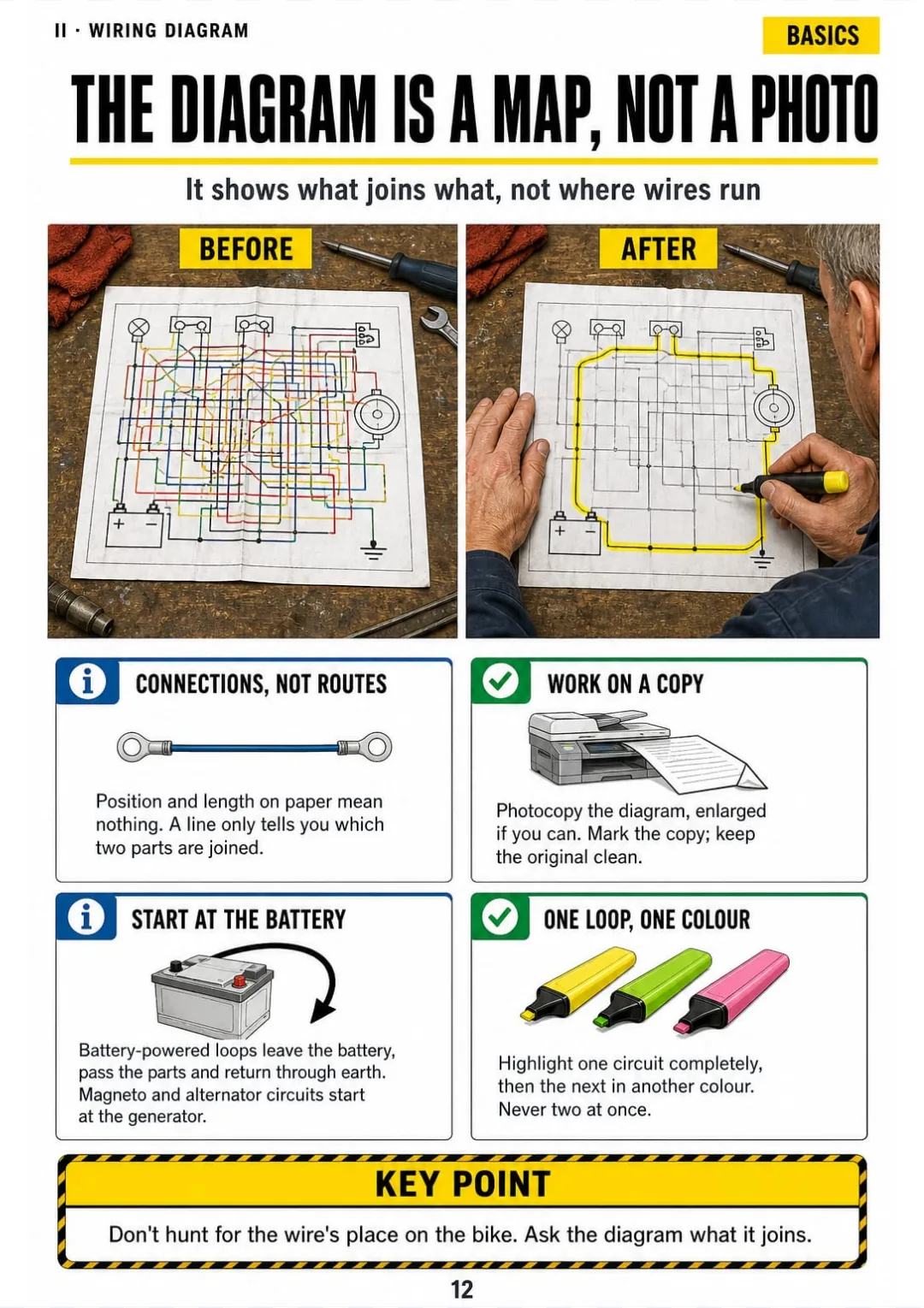
One highlighter, one loop: battery out, through the parts, back through earth.
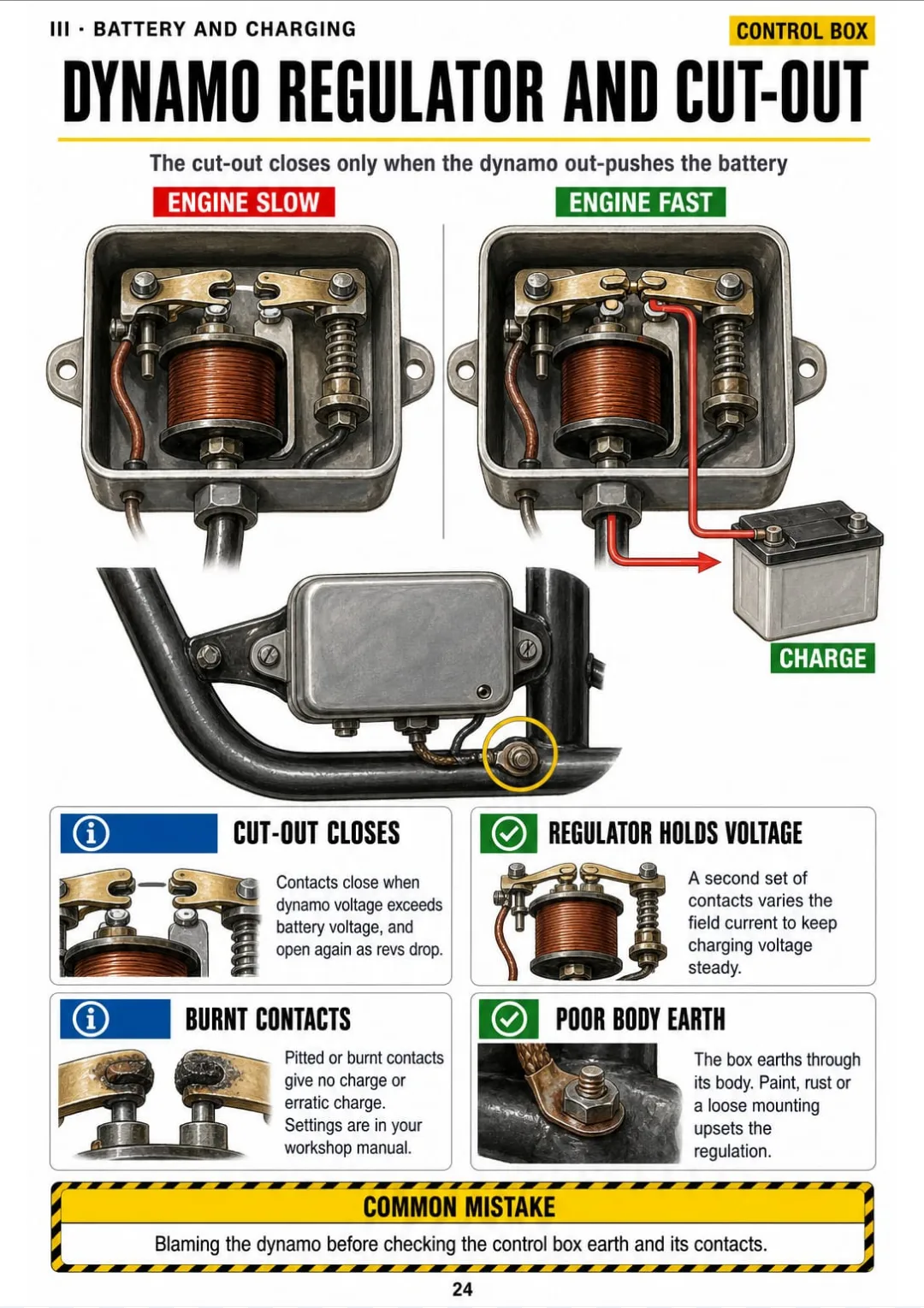
Cut-out contacts close when charge voltage exceeds battery voltage.
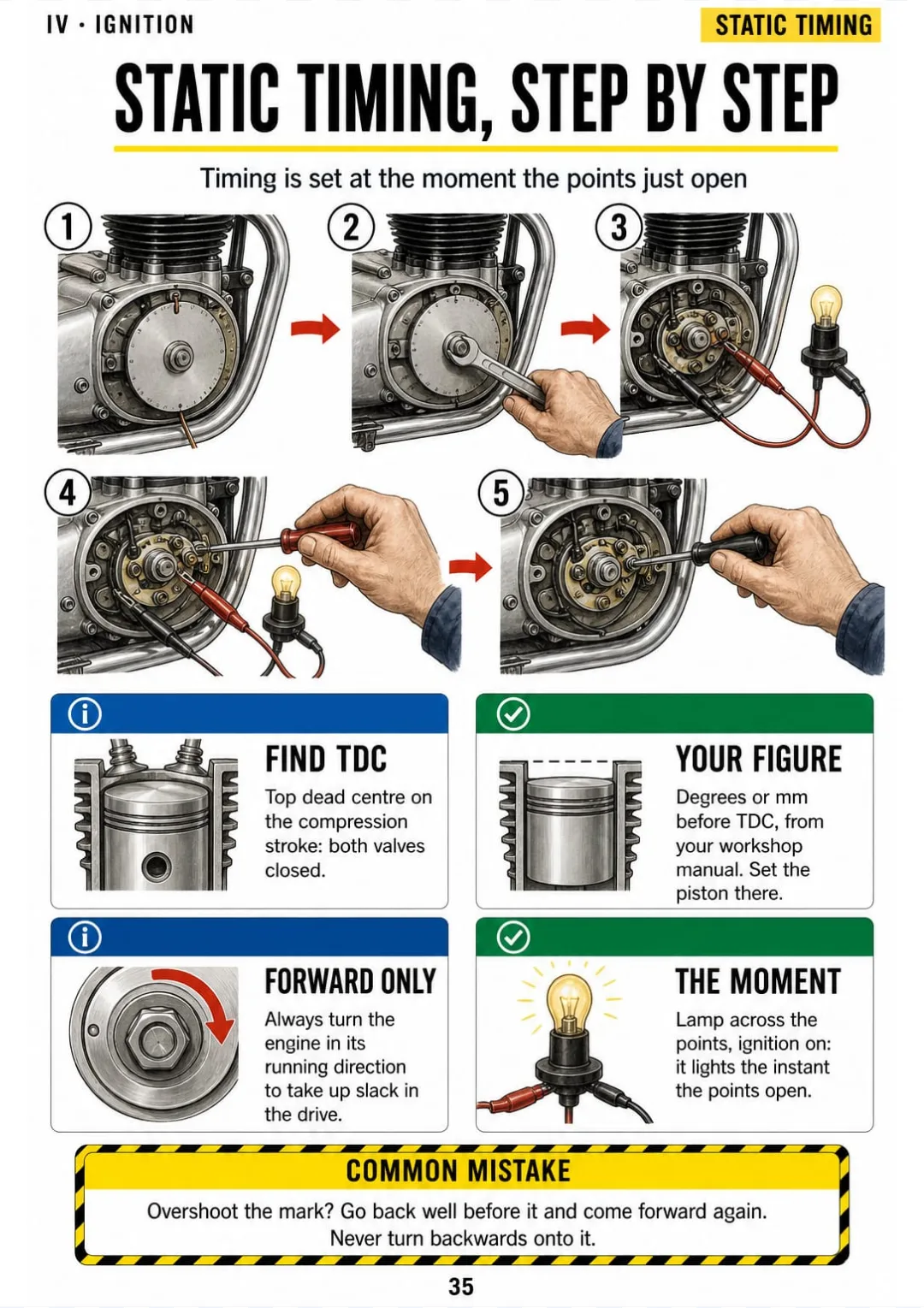
Piston at your manual's figure, lamp across the points: timing set when they just open.
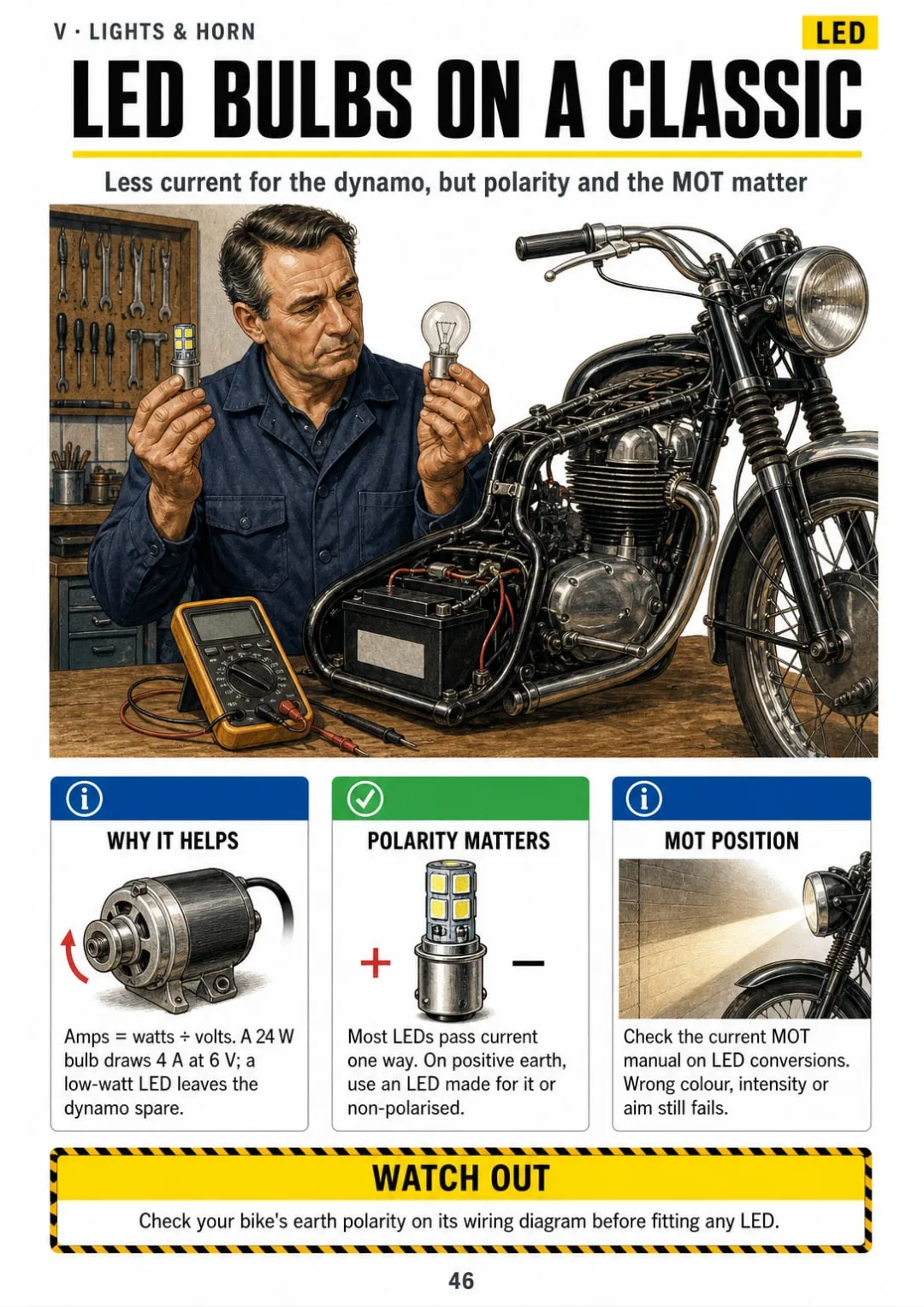
Lower current, less load: and the polarity check that comes first on a classic.
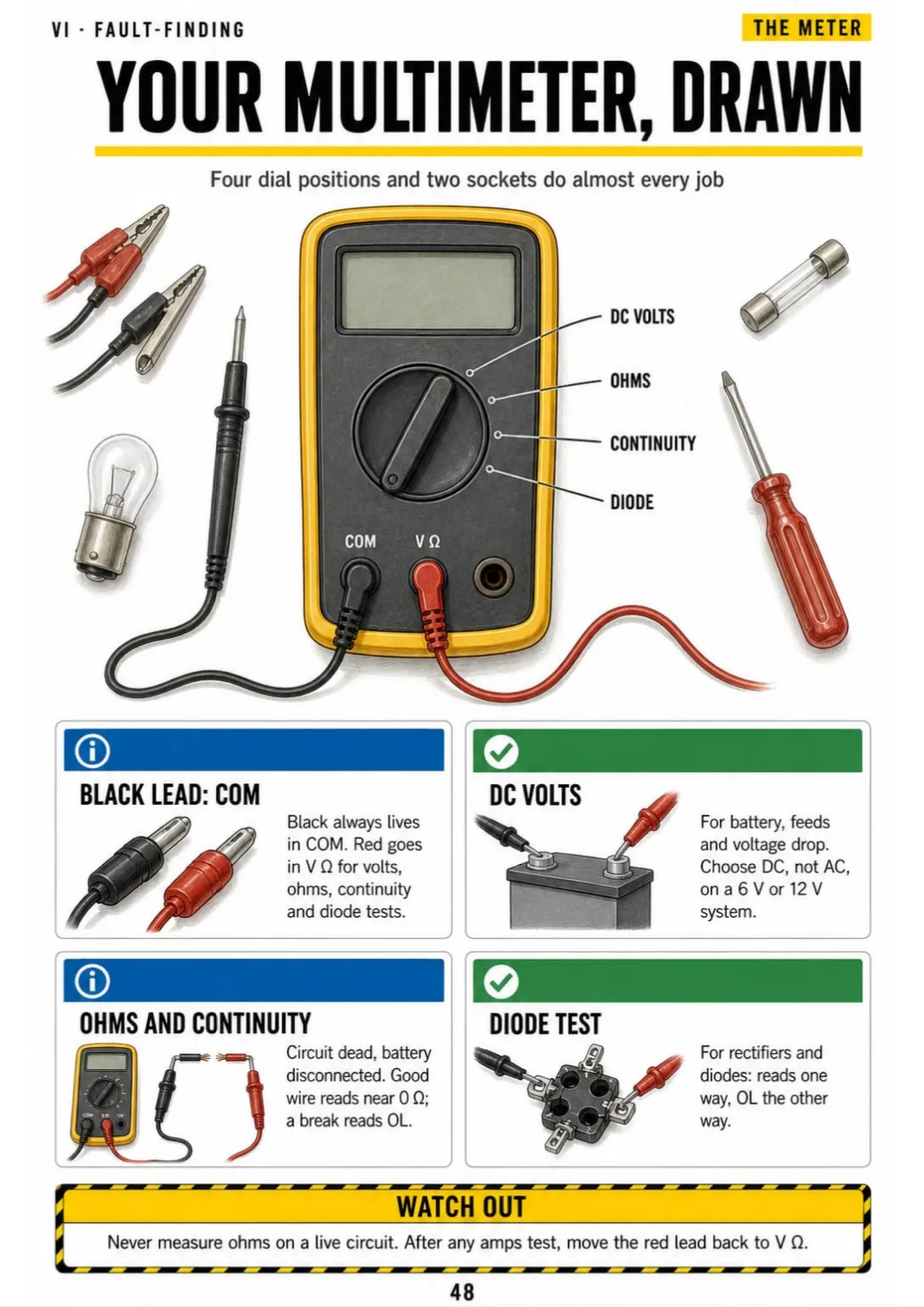
DC volts, ohms, continuity, diode: black in COM, red in V Ω, never ohms on a live circuit.
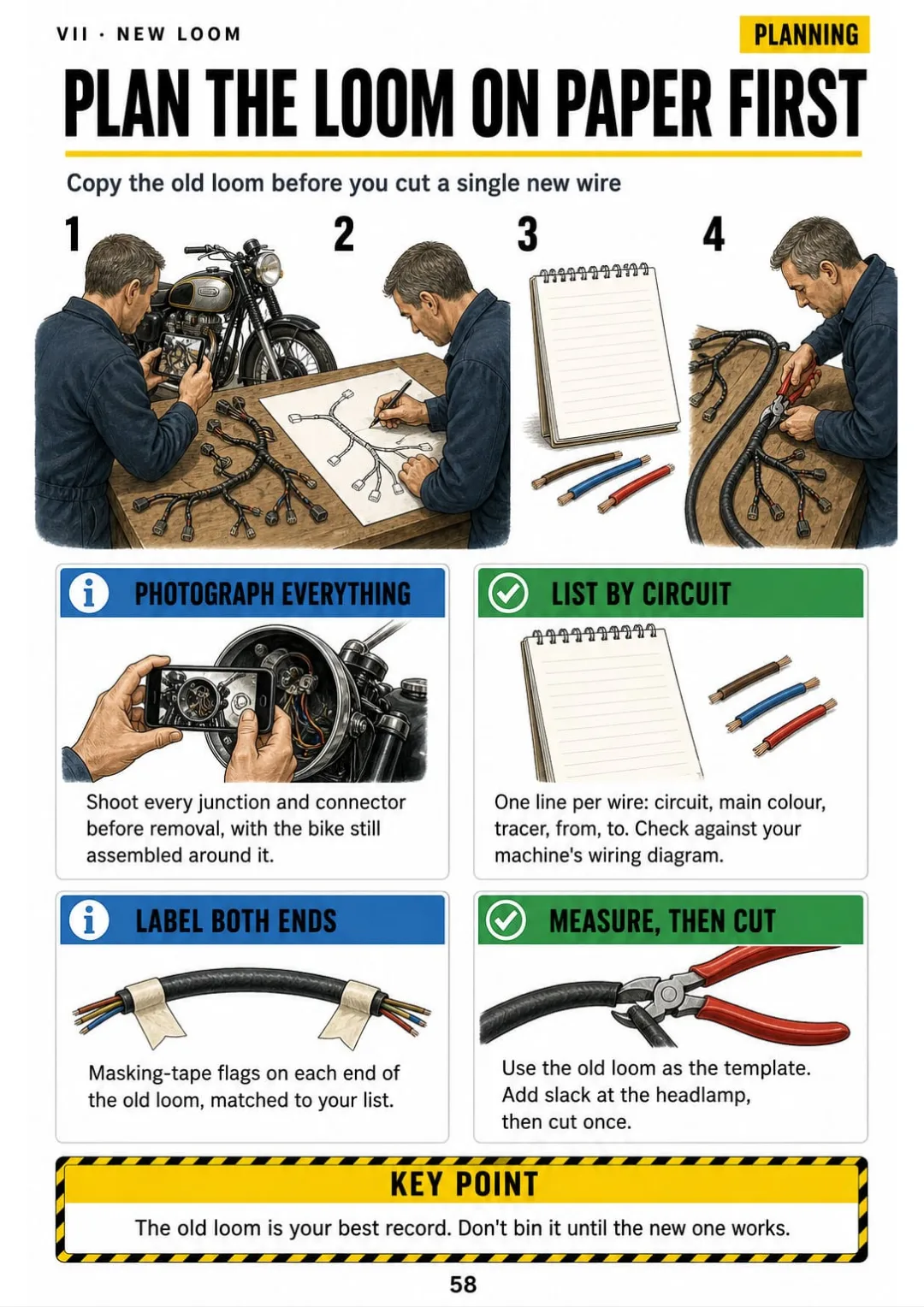
Photograph, draw, list by circuit and colour, then cut once to length.
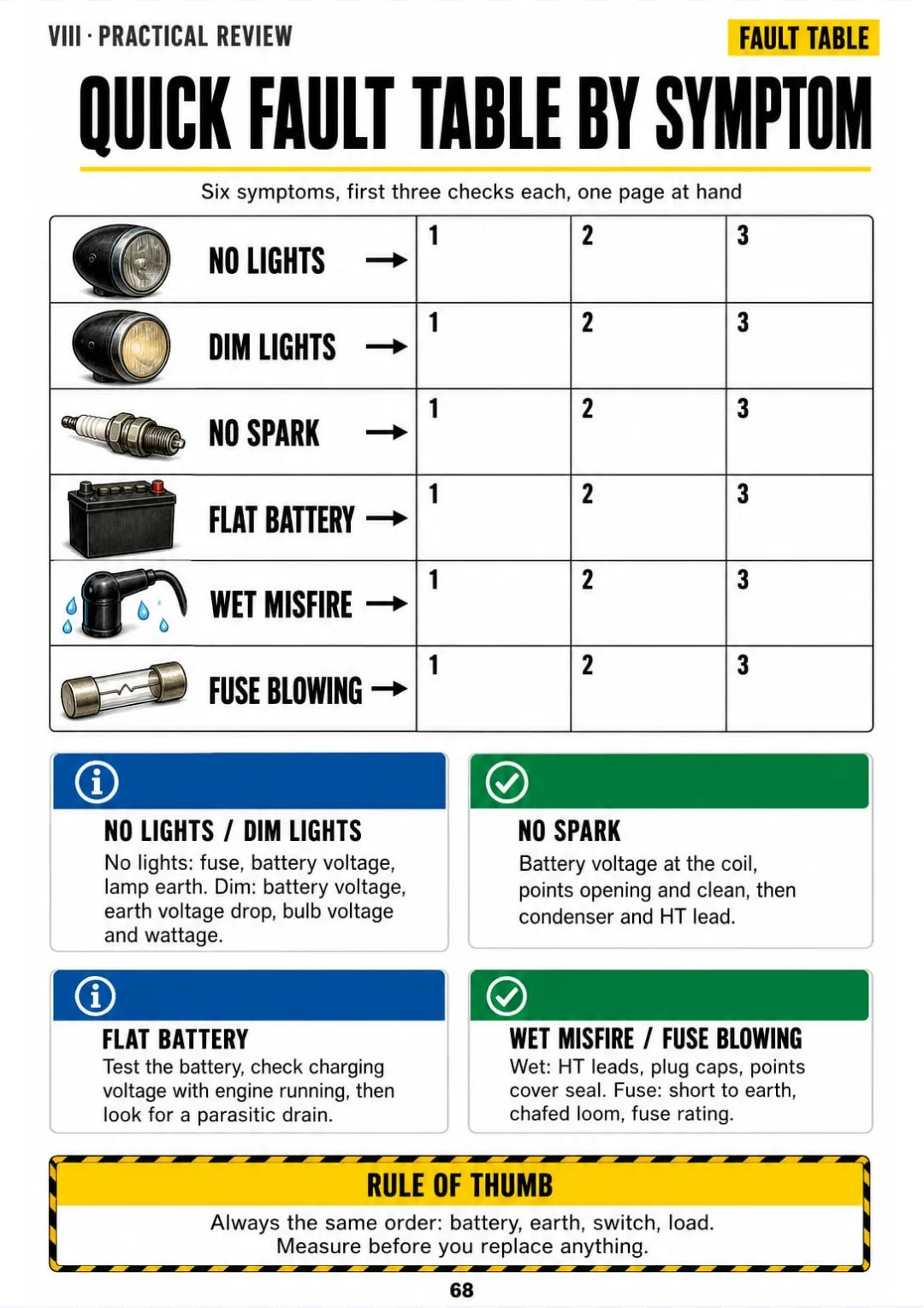
No lights, dim lights, no spark, flat battery, wet misfire, fuse blowing: three checks each.

Swipe to see more →

These are real pages from the book. The table of contents is the full one: 8 parts and 65 topics.

The Problem Isn't You. It's How It Was Explained.

It's Saturday, the bike won't start and you're standing over the battery with the meter reading 12.1 V. Charged, half flat or finished? The number alone doesn't tell you.

The manual gives it three paragraphs on electrolyte, specific gravity and sulphation. Plenty of words, and no picture of what's going on inside the box.

Cut-out contacts close when charge voltage exceeds battery voltage.

In this book the lead-acid battery is one page: six cells drawn side by side, about 2 V each, and a box with around 12.6 V at rest when fully charged. You can see why 12.1 is a warning, not a pass.

The same goes for the dynamo, the rectifier, the points gap, voltage drop on an earth and tracer colours on the diagram. Each one has its own page and its own drawing.

Next time the meter goes on the battery, you know what the reading means and what to check next, without going back to the workshop manual.

COMPARE FOR YOURSELF

Same Topic, Two Ways to Learn It

THIS
  • The manual: line after line
  • Wiring diagrams explained in words alone
  • You get to the bench still unsure
The wiring diagram represents the electrical interconnections of the machine schematically and does not correspond to the physical disposition of the components or the routing of the harness. Conductors are identified by their principal colour followed, where applicable, by the tracer colour. Components are depicted by conventional symbols and may appear at any position on the sheet irrespective of their location on the machine. Earth return connections may be indicated by symbol rather than by a continuous line, the frame being regarded as part of the circuit.
FOR THIS
  • Each circuit in one drawing
  • Colours, readings and checks in a box
  • You see it and you get it
One highlighter, one loop: battery out, through the parts, back through earth.
CONTENTS

Take a Look at the 8 Parts and 65 Topics

The circuit as a loop, reading the wiring diagram, battery and charging, ignition, lights and switches, fault-finding with a multimeter, making a new loom and a practical review: 69 pages, all illustrated.

IThe Circuit as a Loop · pp. 5-11
  1. Every circuit is one loop
  2. Volts, amps and ohms in garage terms
  3. Watts: why a bulb draws what it draws
  4. The frame is half the circuit
  5. Positive earth and negative earth
  6. 6 volt or 12 volt?
  7. Series and parallel on a motorcycle
IIReading the Wiring Diagram · pp. 12-19
  1. The diagram is a map, not a photo
  2. The symbols you'll meet
  3. The British wire colour code
  4. Tracer colours: the second colour matters
  5. Tracing one circuit end to end
  6. The ignition switch on the diagram
  7. The light switch and dip switch
  8. When the diagram doesn't match the bike
IIIBattery and Charging · pp. 20-29
  1. The lead-acid battery, drawn
  2. Testing the battery properly
  3. Charging the battery safely
  4. The dynamo, drawn
  5. Dynamo regulator and cut-out
  6. The alternator, drawn
  7. The rectifier
  8. The Zener diode regulator
  9. Is it charging? The three-step check
  10. The ammeter: friend or fault source
IVIgnition · pp. 30-40
  1. From coil to plug: the spark, drawn
  2. Contact breaker points
  3. Setting the points gap
  4. The condenser (capacitor)
  5. The coil: testing primary and secondary
  6. Static timing with a bulb or meter
  7. Strobe timing
  8. Auto-advance unit
  9. The magneto, drawn
  10. Plugs, caps and HT leads
  11. Electronic ignition conversions
VLights, Horn and Switches · pp. 41-47
  1. Headlamp: pilot, dip and main
  2. Tail and stop lamp
  3. Stop lamp switches, front and rear
  4. The horn and its button
  5. Indicators added to a classic
  6. LED bulbs on a classic
  7. What the law asks of your lights
VIFault-Finding with a Multimeter · pp. 48-57
  1. Your multimeter, drawn
  2. Always the same order: battery, earth, switch, load
  3. Measuring voltage at points along the loop
  4. Voltage drop: the test that finds bad earths
  5. Continuity and resistance tests
  6. Finding a short to earth
  7. Finding a parasitic drain
  8. No spark: the order to check
  9. Not charging: the order to check
  10. Intermittent faults
VIIMaking a New Loom · pp. 58-65
  1. Plan the loom on paper first
  2. Choosing cable size
  3. Crimping a terminal properly
  4. Soldering: when and how
  5. Bullet connectors and snap connectors
  6. Adding a main fuse
  7. Making good earths
  8. Wrapping, routing and securing the loom
VIIIPractical Review · pp. 66-69
  1. The most frequent mistakes on classic electrics
  2. Before the first start after rewiring
  3. Quick fault table by symptom
  4. Your machine's data page

One Page, One Topic, All Clear

Think of it this way:

The headlamp dims at tickover and you need to know whether it's the battery, an earth or the charging. The meter is in your hand and the bike is on the stand.

You open the book at fault-finding and the order is drawn: battery, earth, switch, load, with the reading to expect at each point and a blank box for yours.

Lower current, less load: and the polarity check that comes first on a classic.

The same with the points gap, the rectifier, tracer colours, crimping a terminal and adding a main fuse: each one on its own page.

Classic Motorcycle Electrics Illustrated is 8 parts and 65 topics, all drawn, and at the end a quick fault table by symptom and a data page for your own machine.

What you see drawn, you don't have to memorize.

What's Inside Classic Motorcycle Electrics Illustrated:

Ipp. 5-11

The Circuit as a Loop

See every circuit as one loop and the rest stops being a mystery: volts, amps, ohms and watts in garage terms, the frame as half the circuit, positive or negative earth, 6 V or 12 V, series and parallel.

IIpp. 12-19

Reading the Wiring Diagram

The diagram as a map, the symbols, the British wire colour code, tracer colours, tracing one circuit end to end, ignition, light and dip switches, and when the diagram doesn't match the bike.

IIIpp. 20-29

Battery and Charging

The lead-acid battery, testing and charging it safely, dynamo and its regulator, alternator, rectifier, Zener diode, the three-step charging check and the ammeter.

IVpp. 30-40

Ignition

The spark from coil to plug, points and their gap, the condenser, coil tests, static and strobe timing, auto-advance, the magneto, plugs and HT leads, electronic conversions.

Vpp. 41-47

Lights, Horn and Switches

Headlamp pilot, dip and main, tail and stop lamp, stop lamp switches, the horn, indicators and LED bulbs on a classic, and what the law asks of your lights.

VIpp. 48-57

Fault-Finding with a Multimeter

Fault-finding with your multimeter in one fixed order, battery, earth, switch, load, with the reading to expect at each point: voltage drop, continuity, shorts, parasitic drains, no spark, not charging and intermittent faults.

VIIpp. 58-65

Making a New Loom

Planning the loom on paper, cable size, crimping, soldering, bullet and snap connectors, a main fuse, good earths, and wrapping and routing the loom.

VIIIpp. 66-69

Practical Review

The most frequent mistakes on classic electrics, checks before the first start after a rewire, a quick fault table by symptom and your machine's data page.

At the end of the book: A quick fault table by symptom, the five most frequent mistakes with their fixes and a data page for your own machine.
Plus: 2 Free Books

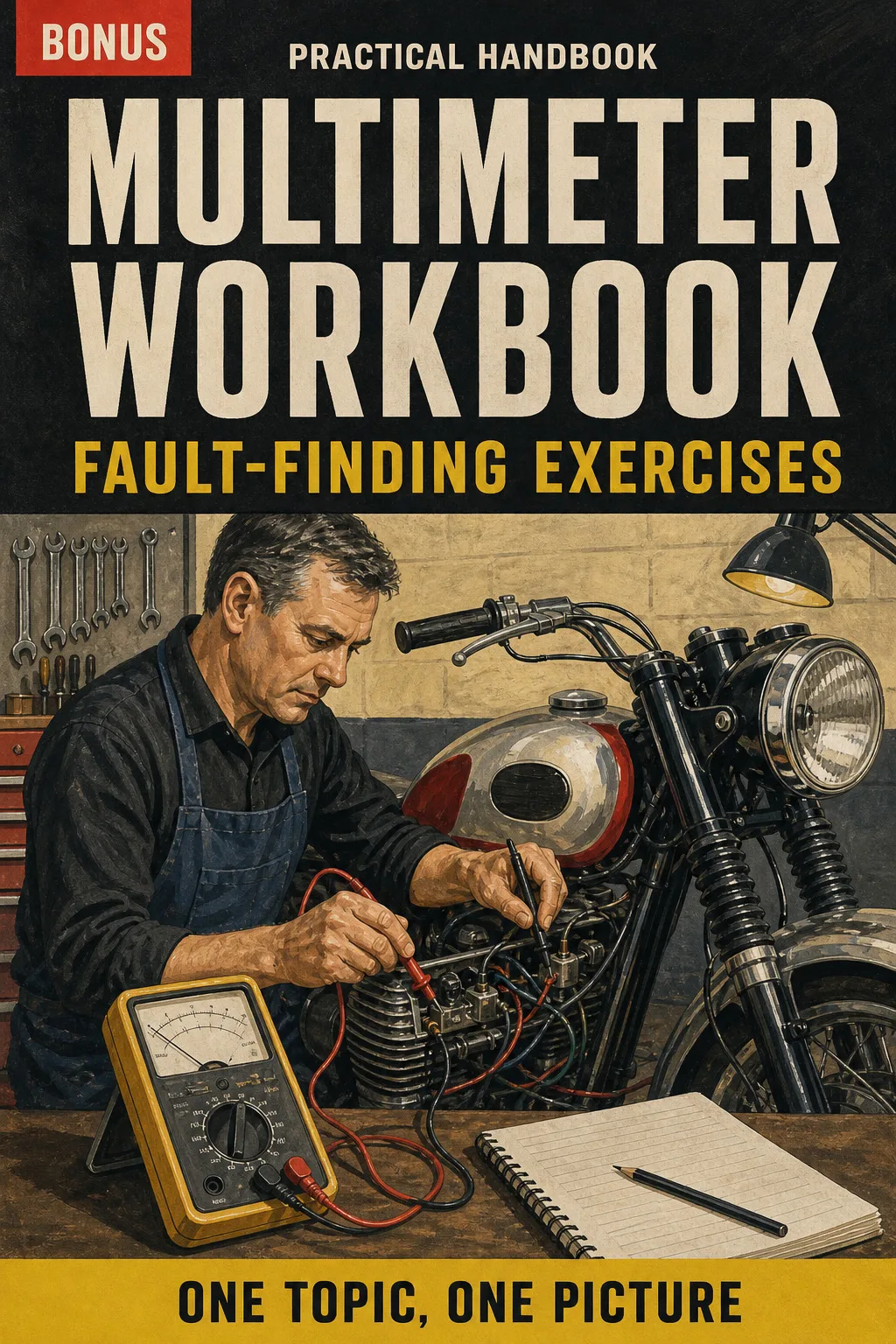
Multimeter Workbook: Fault-Finding Exercises

BONUS 1: «Multimeter Workbook: Fault-Finding Exercises»

Value on its own: US$ 17.90

Practise volts, ohms and continuity tests on drawn circuits, with the reading to expect and blank boxes for yours, before you touch the bike.

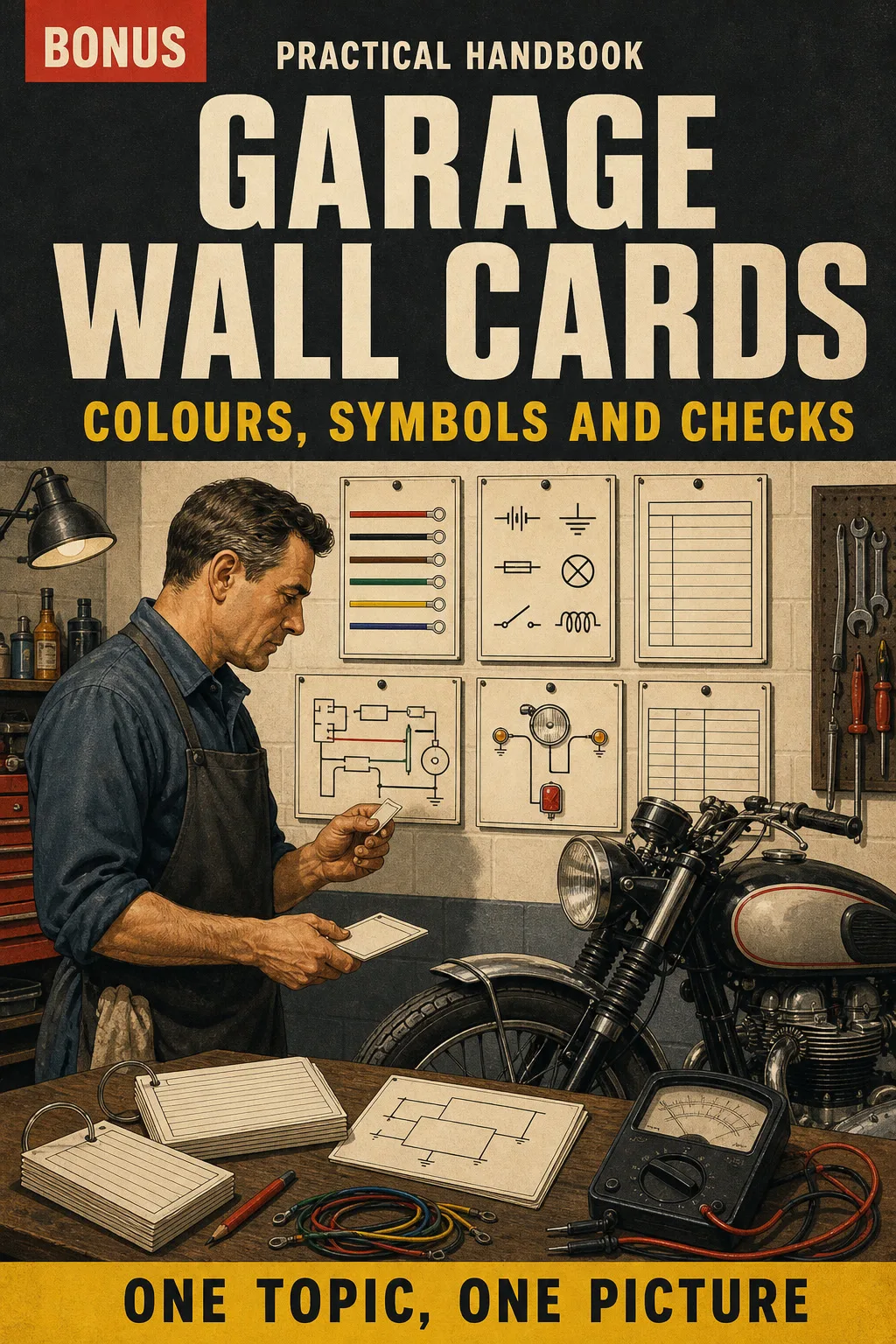
Garage Wall Cards: Colours, Symbols and Checks

BONUS 2: «Garage Wall Cards: Colours, Symbols and Checks»

Value on its own: US$ 14.90

Wire colours, diagram symbols and the fault-finding order on printable cards, so the key facts are on the wall at a glance while you work.

Classic Motorcycle Electrics Illustrated with 2 Free Books

  • Classic Motorcycle Electrics Illustrated: 69 illustrated pagesUS$ 63
  • BONUS 1: Multimeter Workbook: Fault-Finding ExercisesUS$ 17.90
  • BONUS 2: Garage Wall Cards: Colours, Symbols and ChecksUS$ 14.90
  • High-resolution PDF to printIncluded
Total value US$ 95.80
YOUR PRICE:
US$ 27
You save US$ 68.80
YES, I WANT CLASSIC MOTORCYCLE ELECTRICS ILLUSTRATED FOR US$ 27

📄 This is a digital PDF book sent to your email: nothing is printed or shipped.

Secure purchaseEncrypted payment30-day guarantee

PDF by email: We email you Classic Motorcycle Electrics Illustrated as a PDF, together with the two free books. It's a single payment: no installments, no extra charges.

Who This Book Is For

You're starting on the electrics

You're starting on the electrics

You know the mechanics but the wiring puts you off. Every circuit is drawn as one loop, so the diagram finally reads like a map.

A rewire or a 6 V to 12 V job is coming up

A rewire or a 6 V to 12 V job is coming up

Plan the loom on paper, choose cable sizes, crimp, fuse and earth it properly, with a check list before the first start.

You already keep classics running

You already keep classics running

Points, timing, charging and fault-finding in a fixed order, printed and kept on the bench for when a fault turns up.

Everything You Get Today

US$ 95.80US$ 27
YES, I WANT CLASSIC MOTORCYCLE ELECTRICS ILLUSTRATED FOR US$ 27

📄 This is a digital PDF book sent to your email: nothing is printed or shipped.

30DAYS
GUARANTEE

30-Day Guarantee

Try Classic Motorcycle Electrics Illustrated for 30 days, bonus books included.

We refund everything if the file won't open, if the book isn't what you see here, if you were charged twice or if the email doesn't arrive. Just email us.

You pay once. No subscriptions.

Frequently Asked Questions

Is it for me if I know mechanics but the electrics put me off?

Yes. It skips the basics of spanners and goes straight to circuits, charging, ignition and fault-finding. It names no makes or models: it works alongside the wiring diagram for your own machine.

Where does the content come from?

From standard workshop practice, the Road Vehicles Lighting Regulations 1989 (as amended) and the lighting and electrical sections of the DVSA MOT inspection manual for motorcycles. Every figure is marked to check against your machine's own data.

Is it official material?

No. It's an independent illustrated workshop book, not linked to any manufacturer, club or government body.

I've got the workshop manual and the forums. What does this add?

The manual gives you the diagram and the specs; the forums give you ten different answers. This gives you each circuit drawn as one loop, one fixed test order (battery, earth, switch, load) with the reading to expect at each point, and wall cards to pin up in the garage. It doesn't replace your workshop manual or a qualified mechanic: it makes them make sense.

Does it cover my system: 6 V or 12 V, positive earth, dynamo or magneto?

Yes. It covers positive and negative earth, 6 V and 12 V, the dynamo with its regulator, the alternator with rectifier and Zener diode, coil and points, the magneto and electronic conversions. It names no makes or models: every figure is marked to check against your own machine's data.

When and how does it arrive?

As a PDF by email, together with the 2 bonus books, at the address you enter at checkout.

Do I have to pay every month?

No. It's a one-off payment.

Can I have it on paper?

Yes. The PDF prints on A4, so you can keep it on the bench and pin the wall cards up in the garage.

How does the refund work?

You have 30 days. We refund everything if the file won't open, if the book isn't what you see on this page, if you were charged twice or if the email doesn't arrive: just email us.

Before You Close This Page

No more rereading without it sticking.

The charging circuit, drawn and done.

You get to the bench knowing where everything is.

Drawings make studying faster.

The book is right below.

One-time payment: US$ 27 · Guarantee: 30 days · PDF by email

YES, I WANT CLASSIC MOTORCYCLE ELECTRICS ILLUSTRATED FOR US$ 27

📄 This is a digital PDF book sent to your email: nothing is printed or shipped.